Funding Calls
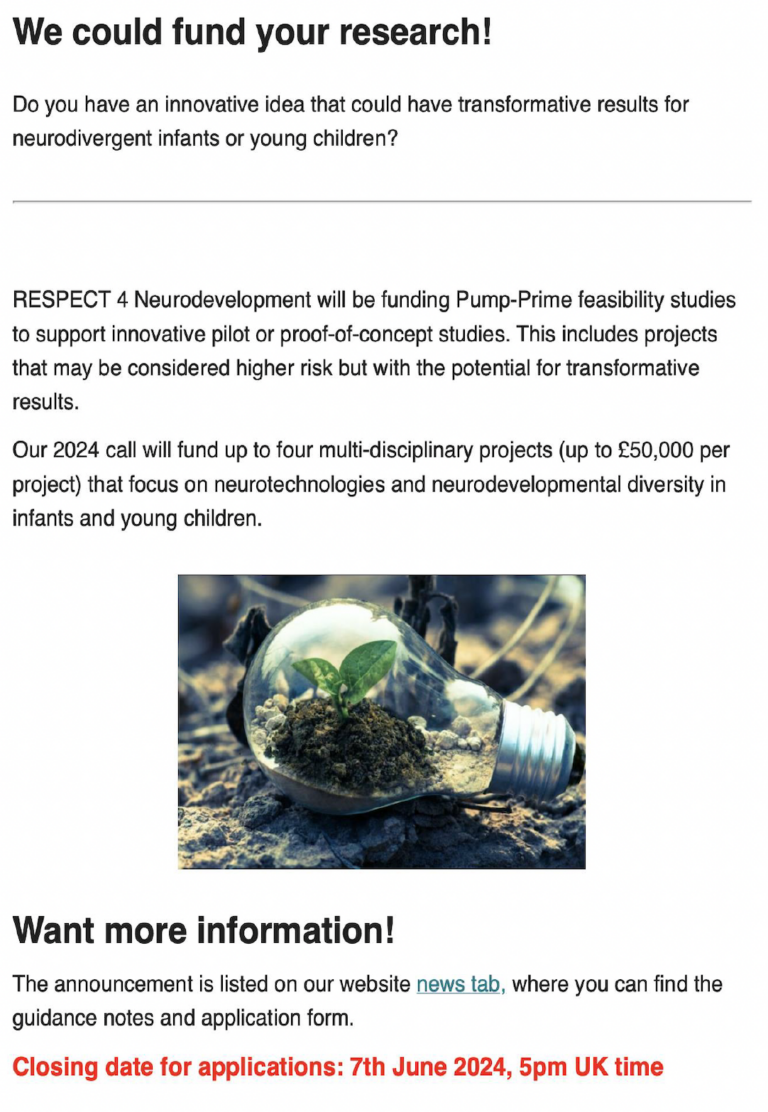
Following our three funding calls, April 2023, June 2024 and April 2025 we have successfully awarded 10 innovative multi-disciplinary projects thus far of £50,000 each, with a maximum duration of 1 year. These calls were advertised initially via; our website, to members directly and through outreach avenues. Each call received a good number of strong applications.
Applicants applied with proposed innovative studies that focused on neurotechnologies for infants and children with neurodevelopmental conditions. Applicants were specifically asked to demonstrate proof of concept of innovative ideas that may then underpin and strengthen subsequent larger grant applications.
The remit of this Request for Applications also includes project proposals that address one or more the core themes of Respect 4 Neurodevelopment: Responsible, Reliable, Scalable and Personalisation of neurotechnology for neurodevelopmental populations. Multi-disciplinary collaborations were also encouraged and an important component within these project proposals, along with involvement of those with lived experiences of neurodiversity. We received a good number of strong applications at each round and those that were shortlisted were invited to pitch their proposals to a panel of senior researchers and people with lived experience of neurodiversity.
The following four innovative multi-disciplinary projects were awarded:

Dr Chiara Bulgarelli at the Centre for Brain and Cognitive Development, Birkbeck, University of London was awarded the grant for her feasibility study: Combining wearable diffuse optical tomography and immersive virtual-reality for the reliable study of neurodevelopmental conditions: a proof-of-principle study to open new avenues of research on neurodiversity.
The team is also composed of Giulia Serino, and Dr. Paola Pinti (Centre for Brain and Cognitive Development, Birkbeck, University of London), Prof. Nicholas Everdell and Dr. Samuel Powell (Gowerlabs Ltd, University College London), Dr. Nadine Aburumman (Department of Computer Science, Brunel University), Prof. Antonia Hamilton (Institute of Cognitive Neuroscience, University College London), Prof. Essi Viding (Clinical, Educational, and Health Psychology Research Department, University College London), Prof. Tony Charman (King’s College London), Siofra Heraty (Child and Family Centre, Meath Primary Care Services, Our Lady’s Hospital, Navan, Co. Meath, Ireland), Silvia Dalvit-Menabe (BabyBrains Limited).
Professor Sam Wass, University of East London, at the school of psychological sciences was awarded the grant for his feasibility study: Developing low-cost wearables to track early home environments in neurodivergent children.
The team is also composed of Computer Scientist Dr Marwa Mahmoud (Glasgow University), Clinician Professor Pasco Fearon (Cambridge University), Professor Carlo Schuengel (University of Amsterdam) and Gemma Goldenberg a parent of neurodivergent children.

Dr Tobias Wood, King’s College London at the department of neuroimaging was awarded the grant for his feasibility study: Comfortable conformal coils for children.
The team is also composed of Ozlem Ipek (KCL, BMEIS), Jennifer Cooke (KCL, Psychology and Neurodevelopmental Science), Matthew Bowdler (KCL, Neuroimaging), Professor Gareth Barker (KCL, Neuroimaging), Eleonora Tilkin-Franssens as a Neurodivergent person with lived & professional experience (University of Leuven) and Professor Steve Williams (KCL, Neuroimaging).
Professor Jo Hajnal, King’s College London, Department of Prenatal Imaging and Health was awarded the grant for his feasibility study: Immersive Virtual Reality for MRI scanning of awake young children with neurodevelopmental conditions.
The team is also composed of Dr Kun Qian (King’s College London, Computer Science and Animation), Professor Graine McAlonan (King’s College London, Clinical psychiatry and translational neuroscience), Laura Bravo (King’s College London, Developmental Psychology) and Dr Tobias Whelan with lived experience of neurodevelopmental conditions.
In April 2024, we gave particular priority to applications that demonstrated Ethical and Responsibility concepts. One of the critical pillars of the network is to ensure that neurotechnologies are ethical, desired, acceptable, and user friendly for neurodivergent children and families. Priority was also given to applications that spoke to underserved communities. The following four projects were awarded:

Dr Julia Foecker, University of Lincoln
W.I.S.E Wheel-Chair Integrated Sensory Education
Our interdisciplinary team includes researchers from Psychology, Computer Science, technicians, as well as teachers working with children with multiple impairments: Polly Atkins (University of Lincoln), Jacqueline Bennison (St Helens Borough Council’ Education and Learning. TESSA Vision), Dr Patrick Dickinson (University of Lincoln), Dr Craig Green (University of Lincoln), Emma Hawes (University of Lincoln), Dr Kieran Hicks (Staffordshire University), Prof. Timothy Hodgson (University of Lincoln), Laura Miles (St Francis Special School, Lincoln), Dr. John Patterson, (St. Vincent’s School, Liverpool), Dr. Jonathan Waddington (InFocus Exeter; Plymouth Marjon University), and Caitlin Williams (University of Lincoln).

Borja Blanco, University of Cambridge
The Effect of Early Adversity on Neurodevelopment: Defining a Biological Poverty Line through Social Brain Fingerprinting
The team is also composed of Dr Sarah Lloyd-Fox (University of Cambridge), Professor Mark H. Johnson (University of Cambridge), Maria Rozhko (University of Cambridge) and Anathi Kwinana (University of Cambridge). The project advisors are Professor Topun Austin (Cambridge University Hospitals NHS Foundation Trust), Dr Nicholas Everdell and Dr Samuel Powell (Gowerlabs Ltd, University College London).

Dr Teresa Del Bianco, London Metropolitan University. Through Their Eyes: Empowering Neurodivergent Perspectives with Eye-Tracking
The multi-disciplinary team consists of Dr. Teresa Del Bianco (London Metropolitan University), Dr. Yanbo Hu (London Metropolitan University), Dr. Georgia Lockwood Estrin (University of East London), Dr. Rianne Haartsen (Birkbeck, University College London), Dr. Rachel O’Connor (St Michael’s House), Dr. Juan Kou (Sichuan University), Professor Paola Venuti, Dr. Arianna Bentenuto (University of Trento), Professor Liz Pellicano (University College London).
Dr Jannath Begum Ali, Birkbeck, University of London
Sleepystaars: Measuring sleep in infants enriched for autism
The multi-disciplinary team consists of Jonathan Baut (Gabi Smart Care Devices), Dr Louisa Gosse (Birkbeck, University of London), Tony Charman (King’s College London).

In 2025, we asked our participatory research group with ‘lived experience’ of nuerodiversity to tell us about their priorities and how neurotechnology could make a positive difference. The two research priorities that emerged from our surveys were:
In line with these priorities, two projects have been awarded and are PPI-led by (a) addressing your priorities and (b) being co-produced between the lead researcher and are participatory research group.
For sensory processing, Dr Nicolaas Puts has been awarded funding for the project “SENSE: Linking Sensory Experiences and Neural Systems in Autism” .

The interdisciplinary team include:
Dafnis Batalle (King’s College London), Carolline Lea-Carnall (University of Manchester) and Peirre Violland (Autism Peer Support Specialist)
For neurotechnologies that can be used in the home, Dr Louisa Gossé has been awarded funding for the project “DeepSleep – real-time neurofeedback platform to improve baby sleep”. Dr Gossé works on the association between sleep and cognitive development in the first years of life.

Interdisciplinary team also consist of:
Dr Poala Pinti (Birkbeck, University College London), Professor Lorenzo Fabrizi (University College London), Professor Tim Smith (Birkbeck, University of London) and Artinis Medical Systems.